
Gratitude
Credit: Michael Lisnet/Simons Foundation
A Short History of Simons
Simons Searchlight is an international research program funded by the Simons Foundation through the Simons Foundation Autism Research Initiative (SFARI). It began in 2010 as the Simons Variation in Individuals Project (Simons VIP), with an initial focus on individuals and families with 16p11.2 deletion and duplication, at a time when little was known about the natural history of these genetic variants.
Over time, the program evolved and was renamed Simons Searchlight to reflect its core goal: collecting high‑quality, standardized natural history data across development and adulthood to help researchers understand genotype‑first neurodevelopmental conditions. Today, Searchlight includes many genes and copy number variants and operates as a long‑term partnership among families, clinicians, and researchers, with SFARI stewarding open, responsible access to de‑identified data and research-ready biospecimens.
Simons Searchlight Quarterly Reports
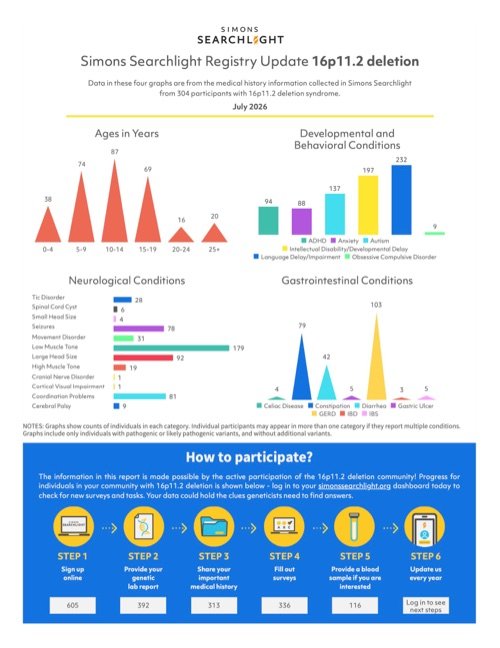
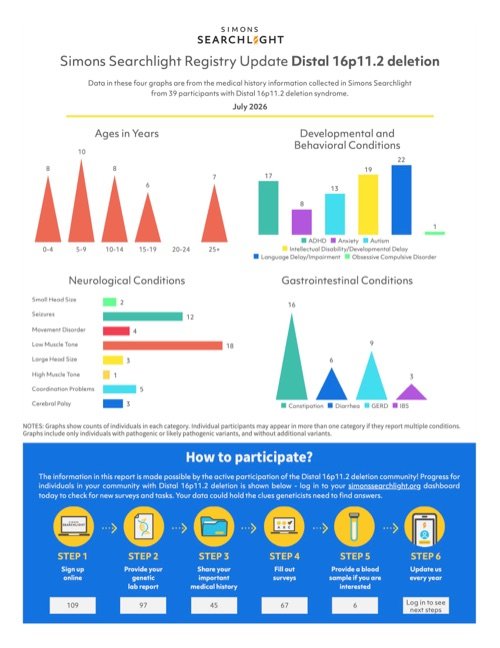
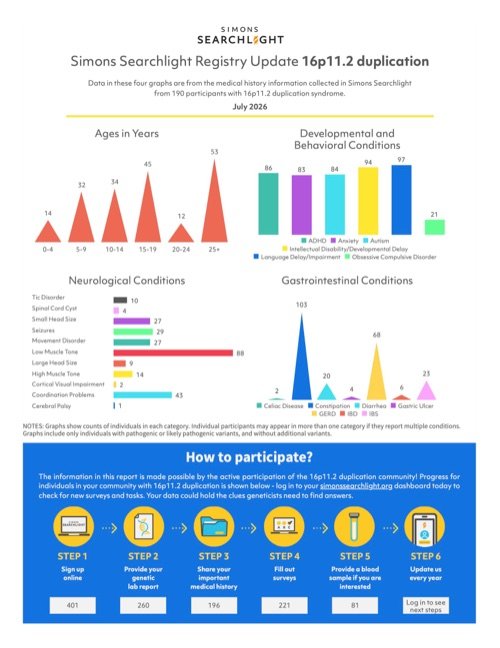
These quarterly reports from Simons Searchlight highlight key findings from participant-reported data, helping families, clinicians, and researchers better understand 16p11.2 syndromes. Every family who participates helps strengthen the data, advance research, and improve our understanding of life with 16p11.2. We encourage all families to enroll in Simons Searchlight and contribute their experiences to help drive future discoveries.
16p11.2 Deletion
Most recent report
16p11.2 Deletion (Distal)
Most recent report
16p11.2 Duplication
Most recent report
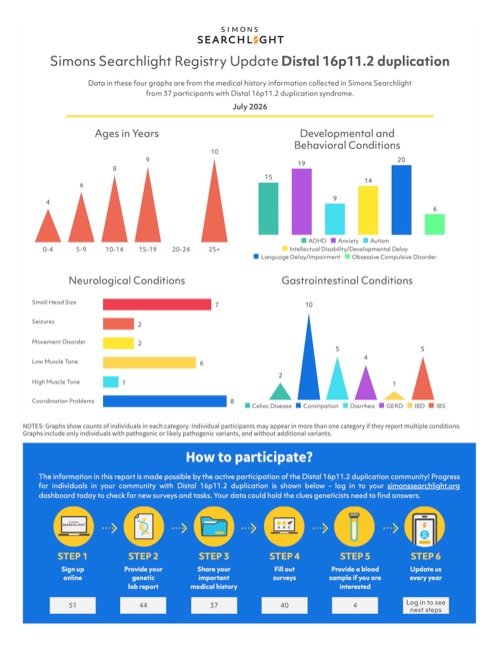
16p11.2 Duplication (Distal)
Most recent report
Previous 16p11.2 Deletion Reports
- Quarter 4 2025/Quarter 1 2026 Report
- Quarter 3 2025 Report
- Quarter 2 2025 Report
- Quarter 1 2025 Report – Vineland Spotlight
- Quarter 4 2024 Report – 2024 Surveys Spotlight
- Quarter 3 2024 Report
- Quarter 2 2024 Report
- Quarter 4 2023/Quarter 1 2024 Report
- Quarter 3 2023 Report
- Quarter 2 2023 Report
- Quarter 4 2022/Quarter 1 2023 Report
- Quarter 3 Report 2022
- Quarter 2 Report 2022
- Quarter 1 Report 2022
- Quarter 4 Report 2021
- Quarter 3 Report 2021
- Quarter 2 Report 2021
- Quarter 1 Report 2021
- Voice of the Community Report 2021
Previous 16p11.2 Deletion (Distal) Reports
- Quarter 4 2025/Quarter 1 2026 Report
- Quarter 3 2025 Report
- Quarter 2 2025 Report
- Quarter 1 2025 Report – Vineland Spotlight
- Quarter 4 2024 Report – 2024 Surveys Spotlight
- Quarter 3 2024 Report
- Quarter 2 2024 Report
- Quarter 4 2023/Quarter 1 2024 Report
- Quarter 3 2023 Report
- Quarter 2 2023 Report
- Quarter 4 2022/Quarter 1 2023 Report
- Quarter 3 Report 2022
- Quarter 2 Report 2022
- Quarter 1 Report 2022
- Quarter 4 Report 2021
- Quarter 3 Report 2021
- Quarter 2 Report 2021
- 16p112. Distal Deletion Quarter 1 Report 2021
- Voice of the Community Report 2021
Previous 16p11.2 Duplication Reports
- Quarter 4 2025/Quarter 1 2026 Report
- Quarter 3 2025 Report
- Quarter 2 2025 Report
- Quarter 1 2025 Report – Vineland Spotlight
- Quarter 4 2024 Report – 2024 Surveys Spotlight
- Quarter 3 2024 Report
- Quarter 2 2024 Report
- Quarter 4 2023/Quarter 1 2024 Report
- Quarter 3 2023 Report
- Quarter 2 2023 Report
- Quarter 4 2022/Quarter 1 2023 Report
- Quarter 3 Report 2022
- Quarter 2 Report 2022
- Quarter 1 Report 2022
- Quarter 4 Report 2021
- Quarter 3 Report 2021
- Quarter 2 Report 2021
- Quarter 1 Report 2021
- Voice of the Community Report 2021
Previous 16p11.2 Duplication (Distal) Reports
- Quarter 4 2025/Quarter 1 2026 Report
- Quarter 3 2025 Report
- Quarter 2 2025 Report
- Quarter 1 2025 Report – Vineland Spotlight
- Quarter 4 2024 Report – 2024 Surveys Spotlight
- Quarter 3 2024 Report
- Quarter 2 2024 Report
- Quarter 4 2023/Quarter 1 2024 Report
- Quarter 3 2023 Report
- Quarter 2 2023 Report
- Quarter 4 2022/Quarter 1 2023 Report
- Quarter 3 Report 2022
- Quarter 2 Report 2022
- Quarter 1 Report 2022
- Voice of the Community Report 2021

How Families Can Contribute to Research Together
When families participate, the registry becomes stronger and more useful.
Ways families can make research possible and more robust for our children:
- Join Simons Searchlight as a participant by enrolling at https://www.simonssearchlight.org and completing consent and baseline surveys
- Contribute longitudinal data by keeping medical, developmental, and behavioral information up to date through annual questionnaires
- Consider donating a blood sample, if eligible and comfortable, to enable creation of research resources such as cell lines and DNA
- Invite others in your genetic community to participate, strengthening the data needed to answer the questions that matter most to families
Data and Biospecimens Available for Research
Simons Searchlight collects information over time so researchers can see patterns and change across childhood and adulthood. This includes family, medical, developmental, and behavioral information gathered through surveys and follow‑ups.
Just as important, SFARI helps make these resources available to qualified researchers through SFARI Base, a centralized portal for autism and related neurodevelopmental research data and biospecimens.
Through SFARI Base, approved researchers may request de‑identified data and, for some participants, biospecimens. SFARI and Simons Searchlight describe available biospecimens such as whole blood DNA, lymphoblastoid cell lines (LCLs), and induced pluripotent stem cells (iPSCs).
These resources are stewarded and distributed based on participant consent through the SFARI Data and Biospecimen Repository (SDBR).